How to Learn How to Read Facial Expressions
Abstract
The ability to read emotions from faces is a very important skill. Ane might fifty-fifty call it a superpower. People effectually the earth utilise this skill when they communicate with each other. But practice people from unlike cultural backgrounds recognize and interpret facial expressions the same mode? The answer, co-ordinate to scientists, is both yep and no. Yes, considering the brain arrangement specializing in understanding faces is similar across cultures, so nosotros all tin recognize bones emotions, such equally happiness or sadness, when looking at other faces. No, because culture influences how we behave and how nosotros think, which means it likewise influences the rules we larn as children that tell us when and how to evidence our emotions. In this article, nosotros talk over how nosotros are able to read emotions from faces and how nosotros might be reading emotions differently, depending on where we are from.
Introduction
Imagine if I told y'all that you could have a superpower that would let you to know something very personal about other people—their feelings. With just one look at a special map, you lot would know if people are happy, sad, angry, or bored, without them telling you anything. Well, about all of us accept this superpower already. And the map that nosotros utilize every day to read other people'southward emotions is the face up.
How can we tell what people are feeling from their facial gestures? Does this superpower work the same style everywhere in the world?
To understand the mechanism behind reading emotions, let us think about the homo face. Have you ever heard the proverb "The optics are the windows to the soul"? Maybe it is a chip unlikely to come across someone'southward soul through their optics (our optics are not existent windows after all), simply one of the reasons why people apply this saying is because the optics are very of import for understanding what other people are feeling. In fact, we can learn a lot virtually others from their facial expressions, and other people tin can tell a lot about us from our faces. Think about all the means y'all can express emotions using but your face! Even babies seem to be born understanding the importance of faces, because every bit early equally 9 minutes after nascence, babies prefer to wait at faces rather than any other objects [1]. Past the time they are 12 days old, babies can already imitate the facial gestures of adults [2]. This ability is very important for their development because it helps them to later learn how to speak and to think.
The Role of the Brain in Reading Faces
Just why is it important for us to be able to read emotions from other people's faces? The reason is that agreement others' emotions can be important for our survival and well-being. Imagine, for example, that on ane sunny day, you lot and your friend are continuing in a field and talking about your favorite game. Yous are laughing and chatting and enjoying your conversation. Suddenly, your friend'southward face up turns from grin to scared, and his eyes abruptly shift from looking at you to looking behind you. Now your friend has yous actually concerned. And you should be! You plough effectually and follow your friend's gaze and what practise you come across? A huge, hungry acquit running toward you! In this example, your power to read your friend'due south emotions from his facial gestures might save your life (superpowers can do that).
It is, therefore, no surprise that the brain is very much involved in interpreting data from others' faces. Scientists take discovered that big parts of the brain are responsible for agreement what nosotros see. Regions of the brain that participate in this function are part of what is called the "visual system" and it is located largely at the back of the encephalon, in what is chosen the occipital lobe (scarlet region in Figure 1A). Within the visual system, there is a special part that plays an of import role in interpreting information revealed by faces, such as who someone is and how she feels. This expanse is called the fusiform face expanse, which is part of the fusiform gyrus (for short FFG, see Effigy 1B). Using special equipment to have images that measure the amount of oxygen in the encephalon, called a functional magnetic resonance imaging scanner, scientists have shown that when people wait at pictures of faces, the fusiform area of the brain shows more action, compared with when the aforementioned people wait at pictures of nature or houses [3].
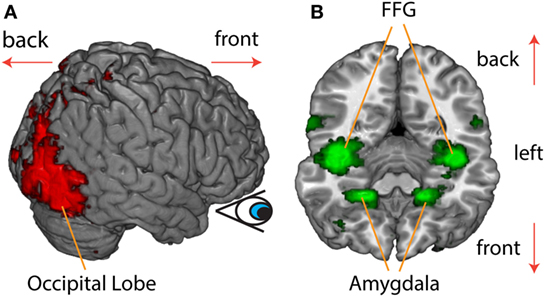
- Figure 1
- Important regions in the confront perception network of the encephalon. This effigy shows regions that are cardinal to interpreting facial expressions of emotions. Panel A shows the occipital lobe (in red), which is an essential part of the brain system that interprets information that nosotros take in with the eyes. In Panel B, you are looking at the brain as if a person that is a piddling smaller than y'all is looking straight at you. The effigy shows the fusiform gyrus (in green), which is important for understanding who someone is and what they are feeling, and the amygdala (in green), which is important for understanding emotions. The amygdala is a smaller region located on both sides of the brain. The brain figures were created using Neurosynth, an online tool that combines information from many functional magnetic resonance imaging studies.
To understand emotions, the visual system works together with other parts of the brain. One of these parts is called the amygdala . The amygdala is very important for reading others' emotions. It is located in the lower part of the brain (Figure 1B). So, whenever you try to understand your friends' emotions, your amygdala and your FFG communicate with each other. When dissimilar areas of the brain frequently talk to each other, these areas form a network. The FFG and amygdala are part of the face perception network of the brain [four]. When parts of the confront perception network are damaged, for instance considering of an blow, then people will have difficulty recognizing others' faces and interpreting others' emotions [v]. Sometimes, they can even have trouble recognizing their ain faces when they look in the mirror. This is a status that is chosen prosopagnosia, which is also known as face up blindness.
How Does Civilization Influence the Manner We Show Emotions?
Homo beings around the world have similar brain structure and apply like facial muscles to express basic emotions such every bit happiness, sadness, fright, surprise, acrimony, and cloy. Does this mean that we all limited and read each other'due south emotions the same way? The answer, according to scientists who study emotions, is both yeah and no. While many experiments have shown that people around the world can accurately recognize basic emotions, such as happiness, sadness, acrimony, and fearfulness, other inquiry has shown that there are differences in the way people read facial expressions depending on where they are from. This makes sense when we consider that people in different cultures do not all deport and retrieve the same way.
One of these cultural differences is institute in display rules . Display rules are rules that we larn as children that tell united states how and when to express our emotions. For case, in some countries, like the US, brandish rules say that information technology is OK to show our emotions to others when we are very sad or very happy, and it is polite to look into people'southward eyes while doing so. In other countries, like Japan, display rules say that information technology is better not to prove also many stiff emotions effectually other people, and that looking into people's eyes is considered impolite. Scientists have been studying display rules for many years and in many different cultures, in order to empathise how they influence the way people around the globe express and read emotions. Near 50 years agone, a now famous experiment showed how display rules differ across cultures [6]. In this experiment, American and Japanese participants were asked to sentry stressful videos ii times. The first time, they watched the films alone, and the 2nd time, they watched with another person (an experimenter) in the room. The experiment showed that both the Japanese and American participants had similar facial expressions when they watched the movies alone. But when there was someone else in the room with them, the Japanese participants preferred non to show their negative feelings. Instead, in order to hide their negative feelings, they began to smiling. The Americans, on the other hand, continued to brandish their negative emotions in front end of the experimenter. Scientists concluded that the reason why the Japanese and American participants acted differently in the presence of other people was because of the brandish rules they had learned in their cultures.
People from Different Cultures Analyze Emotion Expressions Differently
Display rules not only tell united states how and when to express emotions but also influence how we see and understand emotions in others. For instance, in some cultures, people are used to seeing faces that show a lot of strong emotions. In others, where display rules say that emotions should not always exist strongly expressed, people are used to faces with less expression. When you see emotional expressions of similar forcefulness often enough in your own culture, this influences the way you read those emotions from facial expressions.
And so, what if you want to effigy out what someone is feeling. Which function of the face gives you your biggest inkling? The respond to this question comes from experiments that used eye trackers. An eye tracker is a special device that monitors eye movements and, therefore, tin tell scientists exactly where a person is looking. Eye trackers permit scientists to written report what regions of the face people pay most attending to (for example, the eyes or the mouth) when they are trying to understand others' emotions. These experiments showed that depending on where people are from, they focus their attention on different parts of the face when trying to effigy out what others are feeling. Eastward Asian participants, for example, mostly look for clues from the eyes. Western participants discover their clues more than from the whole face, including the optics, the eyebrows, the nose, and the mouth. This suggests that people from different cultures express their emotions using dissimilar facial signals, and also, unlike cultures clarify facial gestures differently [seven]. One reason for these cultural differences is that display rules besides influence the way nosotros procedure information from the face and the mode we categorize this information into emotions.
What if you saw a face where the eyes and the mouth are showing unlike emotions (for example, the eyes are sad, but the rima oris is happy)? Would yous pay more than attention to what the eyes are displaying or what the mouth is displaying? One experiment showed that people volition have unlike answers depending on their civilisation [8]. Japanese people mostly read the emotion signaled by the optics, while Americans focused more on the mouth region to read the emotion. In fact, y'all can meet a similar pattern when you look at emoticons (emojis) used in different cultures. Emoticons are symbols that use letters, punctuation marks, or numbers to limited emotions. In Asia, for case, most emoticons use different heart shapes to limited different emotions. In western cultures, most emoticons use different mouth shapes to express emotions (Figure 2).
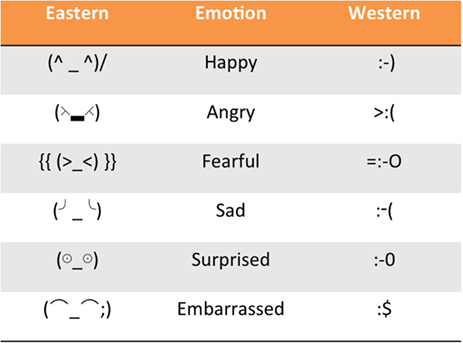
- Figure two
- Emoticons commonly used in eastern and western cultures. This figure shows how emoticons commonly used in eastern cultures, such equally Japan (left column) and western cultures, such equally the Us (correct column) differ. Emotions expressed by emoticons are listed in the middle cavalcade. Discover how the eastern emoticons express different emotions via the middle region, while western emoticons express emotions mostly with the oral fissure.
Training and Testing Your Superpower
Reading faces is a superpower that yous can get amend at the more you lot learn almost information technology and the more y'all exercise information technology. There are as well unlike games yous could play with your friends to meet who amidst you is better at reading emotions. For instance, you could make pictures or cards with faces expressing unlike emotions (happy, angry, sad, surprised, afraid, disgusted). So someone can pull a carte and attempt to enact the emotion from the card without using any words—just their faces. Others should judge which emotion the person with the card is trying to portray. As a bonus, you will get to practice your acting skills!
Ane fashion to examination your emotion-reading skills is the "Reading the Heed in the Optics Test," which was developed by British scientist Simon-Businesswoman Cohen. In this examination, participants rate emotional expressions based just on pictures of the eyes, then without seeing the remainder of the face. This is relatively difficult and frequently feels like guessing, just it turns out that most people are quite skilled in doing this task. A overnice online version of this exam tin be found at this link. i
Conclusion
Nearly of us take the superpower of existence able to read other people's emotions and we all use the aforementioned map—the confront—to do it. All the same, equally scientists have shown, we may be using the map a flake differently depending on where we are from, despite using the same brain systems. The cultural differences in our beliefs, behaviors, and brandish rules volition influence the way nosotros both show and read emotions. These cultural differences volition even bear upon which facial clues we choose to focus our attention on when reading emotions. Learning about these differences in the way people read emotions may help usa communicate with people from effectually the world more successfully.
Glossary
Fusiform gyrus: ↑ The fusiform gyrus is located at the bottom of the brain and stretches throughout almost 2/3 of the length of the brain (starting in the occipital lobe shown in Figure 1A and extending forward through the temporal lobe). It is involved in visual perception, such as understanding color. Importantly, the fusiform confront area is part of the fusiform gyrus, and this region is particularly important for understanding faces (and torso parts).
Functional magnetic resonance imaging (fMRI): ↑ A medical technique that allows scientists and medical professionals to make images of the encephalon with the aid of strong magnetic fields. MRI scanners can take iii-dimensional pictures of the structure of the encephalon and also measure the oxygen content of the blood that flows to the encephalon. The changes in the oxygen content of the blood reflect how agile neurons are and tin can, therefore, be used to measure out encephalon activeness during functional MRI.
Amygdala: ↑ The amygdala is a region in the brain that is shaped like an almond. It can be plant on both sides of the brain, about where a direct line fatigued through the optics meets with a straight line fatigued through the ears. It is involved in a number of behaviors, including learning and memory, emotions, and detecting important events in the surround.
Display rules: ↑ Rules well-nigh when, where, and how it is advisable to express emotions. Commonly, people learn these rules as they brainstorm to socialize with others from their own civilization. Scientists have shown that depending on the civilization that people come from, at that place might be differences in display rules.
Conflict of Interest Statement
The authors declare that the enquiry was conducted in the absenteeism of any commercial or fiscal relationships that could be construed as a potential disharmonize of involvement.
Footnote
[1] ↑ http://socialintelligence.labinthewild.org/mite/
References
[ane] ↑ Morton, J., and Johnson, M. H. 1991. CONSPEC and CONLERN: a two-process theory of infant face recognition. Psychol. Rev. 98(2):164–81. doi:ten.1037/0033-295X.98.2.164
[2] ↑ Meltzoff, A. North., and Moore, Grand. 1000. 1977. Simulated of facial and manual gestures by human neonates. Science. 198(4312):75–eight. doi:10.1126/science.198.4312.75
[3] ↑ Kanwisher, Northward., McDermott, J., and Chun, M. Thousand. 1997. The fusiform face area: a module in human extrastriate cortex specialized for face up perception. J. Neurosci. 17(eleven):4302–11.
[4] ↑ Ishai, A. 2008. Permit's face it: it'southward a cortical network. Neuroimage forty(ii):415–9. doi:10.1016/j.neuroimage.2007.ten.040
[five] ↑ Wada, Y., and Yamamoto, T. 2001. Selective harm of facial recognition due to a haematoma restricted to the correct fusiform and lateral occipital region. J. Neurol. Neurosurg. Psychiatry 71(2):254–7. doi:10.1136/jnnp.71.2.254
[6] ↑ Ekman, P. 1971. Universals and cultural differences in facial expressions of emotion. In: Cole J., editor. Nebraska Symposium on Motivation. (Vol. 19), Lincoln, NE: University of Nebraska Press. p. 207–82.
[7] ↑ Jack, R. E., Blais, C., Scheepers, C., Schyns, P. G., and Caldara, R. 2009. Cultural confusions bear witness that facial expressions are not universal. Curr. Biol. 19:1543–8. doi:10.1016/j.cub.2009.07.051
[eight] ↑ Yuki, Chiliad., Maddux, Westward. W., and Masuda, T. 2007. Are the windows to the soul the same in the Due east and Westward? Cultural differences in using the eyes and oral fissure equally cues to recognize emotions in Japan and the United states of america. J. Exp. Soc. Psychol. 43(ii):303–11. doi:ten.1016/j.jesp.2006.02.004
Source: https://www.frontiersin.org/articles/238894
0 Response to "How to Learn How to Read Facial Expressions"
Post a Comment