What Did Hitler Think About Modern Art and What Name Did He Give It
B efore entering politics Adolf Hitler was a painter. Twice rejected for a place at Vienna's Akademie der bildenden Künste (Academy of Fine Arts), he had strident views on the nature of art and its role in society – ones he did not carelessness even in the midst of the Nuremberg rallies.
"It is not the mission of fine art," the Führer proclaimed to the assembled crowd in September 1935, "to wallow in filth for filth'due south sake, to pigment the human being only in a state of putrefaction, to depict cretins as symbols of motherhood, or to present plain-featured idiots equally representatives of manly forcefulness."
This quotation appears on a wall of a Munich art gallery two years later on, when the Nazis displayed hundreds of seized artworks they declared entartet (degenerate). Jews and communists, abstract pioneers, and especially the Expressionists of the Dresden-centered movement known as Die Brücke (The Span) were condemned equally sick, poisonous artists in the Degenerate Fine art testify of 1937. It was i of the nearly infamous exhibitions of the 20th century; it was also one of the best attended. And its effects are beingness felt even today – witness the contested cache of paintings hoarded past Cornelius Gurlitt, whose father sold numerous paintings in that prove.
Degenerate Art: The Set on on Modern Art in Nazi Federal republic of germany, 1937, which opened this calendar week at New York'due south Neue Galerie, reconstructs non just the Munich exhibition that destroyed so many artistic careers, merely the rhetoric that made the exhibition possible. It'southward the first evidence since this museum of High german and Austrian art opened in 2001 to reckon exclusively with the Nazi period, and it's a welcome stride forward.
The Neue Galerie has devoted solo shows to many of the artists here, from Kandinsky and Kokoschka to Otto Dix and Ernst Ludwig Kirchner, and usually those exhibitions trailed off at the cease of the Weimar flow with a brief, dutiful reminder of the horrors to come.
This show pushes into the 1930s, and it features not only art deemed degenerate but also Nazi-approved painting and sculpture, party propaganda, and films such as the hideously anti-Semitic treatise Der ewige Jude (The Wandering Jew). The event is bracing, and if the exhibition is a footling thin in parts – the 50 paintings exclude several major figures, such every bit Max Ernst and László Moholy-Nagy – the history of the works that are hither makes up the difference.
Attacks on art began almost immediately after Hitler's accession in 1933, often in spontaneous, private Schandausstellungen ("shame exhibitions").
Dix, who earned the Atomic number 26 Cross equally a soldier during the first world war, was a favourite target of these proto-Degenerate Art shows; his glorious grotesques such as War Cripples (1920), they claimed, were insufficiently patriotic. War Cripples was included in the later Munich exhibition and was subsequently destroyed. The Neue Galerie has a contemporary postcard of the lost work, as well equally the painting's frame, hanging empty.
Past 1937 a commission led by Adolf Ziegler, Hitler's favorite painter, was charged with purging German museums of unacceptable art. About 600 of those seized works were included in the Degenerate Art exhibition, which opened on 19 July 1937 – the day later Hitler'south Great High german Art show at the purpose-congenital, gruesomely fascistic Haus der Deutsche Kunst (renamed the Haus der Kunst, this gallery is now directed by the remarkable Nigerian curator Okwui Enwezor and presented an beauteous exhibition in 2012 on its Nazi history). Where the art in the Great High german Art show hung in neoclassical style, the Degenerate Art show displayed paintings cheek-by-jowl on the walls, ringed with angry or derisive texts such as "madness becomes method" or "revelation of the Jewish racial soul."
The Neue Galerie show wisely refuses to recreate that 1937 hang. The art here has ample room to breathe; Nazi slogans are kept off the walls. Instead the curator, High german art historian Olaf Peters, has included a short moving picture taken at the two Munich shows. These bear witness the galleries of the Degenerate Art exhibition crowded with visitors, but nobody looks shocked or disgusted. Many might have been seeing mod art for the very first fourth dimension.
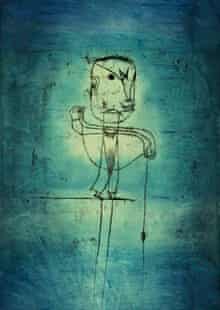
Simply a small number of the artists in the degenerate art shows were Jewish. Felix Nussbaum, a surrealist who was murdered at Auschwitz, was not included; Emil Nolde, a Nazi party member whose autobiography is laced with anti-Semitism, was. Degeneracy was a fluid concept, applied to a wide swath of artists, and their fates varied as much as their paintings. Paul Klee, represented hither past three exquisite watercolors that all hung in Munich, made it to Switzerland, but he couldn't obtain citizenship thanks to Nazi condemnation. Dix fled to the German countryside, Beckmann to the netherlands and so America. Kokoschka, in Uk, proudly painted his "self-portrait equally a degenerate artist". Kirchner killed himself.
Nevertheless central aesthetics were to Nazism, Peters takes pains to clarify that the party'south views of art did not come out of nowhere. The concept of degeneracy – the idea that artists could have pathological disorders, that their art could be not simply bad but sick, even contagious – was widely debated during the era of Bismarck, virtually prominently by the Austro-Hungarian physician and critic Max Nordau, whose 1892-93 book Entartung ("Degeneration") warned that any society could be corrupted by decayed ideas of beauty and virtue. "Degenerates are not e'er criminals, prostitutes, anarchists and pronounced lunatics; they are often authors and artists," Nordau argued. His theories on art and illness ripple through the writings of Nazi race ideology, including Mein Kampf – even though, in one of the about brutal ironies of modern art history, Nordau was not only Jewish only a committed Zionist, and he's buried in Tel Aviv.
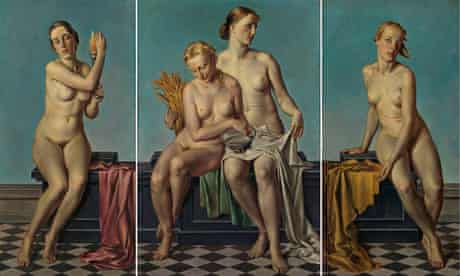
For the Nazis, modernism was not just an inferior or distasteful style. Information technology wasn't even just non-Aryan. Modernism was a swindle – a dangerous lie perpetuated by Jews, communists, and even the insane to contaminate the torso of German society (they were fond of medical and corporeal metaphors, the Nazis). The stakes are articulate in the largest gallery of this show, which features two triptychs side by side. On the correct is Beckmann's Difference, a grand and enigmatic allegory of hope in the confront of persecution. On the left is Ziegler'south The Iv Elements, a kitsch, insensate, classicised-to-expiry depiction of four nude, racially idealised women, their breasts round equally grapefruits.
"German Volk, come and judge for yourselves!" Ziegler proclaimed at the opening of the Degenerate Art exhibition. The Germans of 1937, of course, had no such liberty of judgment. Departure, similar all of Beckmann's work, was purged from the country and concluded up in the Museum of Modern Fine art in New York by 1942. The Four Elements stayed in Munich – and hung in Adolf Hitler's house, over the fireplace.
0 Response to "What Did Hitler Think About Modern Art and What Name Did He Give It"
Post a Comment